The Secret to Interviews That Actually Feel Like Conversations

When someone looks directly into the lens, something magical happens.
Not "pretty good" magic. Real magic.
The audience feels seen. They lean in. They listen. Because for a split second, it feels like that person on screen is talking directly to them.
But here's the problem: 98% of interview setups completely miss this opportunity.
The Old Way (That Everyone Still Uses)
You've seen it a thousand times in documentaries:
Set up the camera. Dial in the lighting. Position the interviewer just off-frame, sitting awkwardly next to the camera, trying to get the subject's eyeline as close to the lens as possible without actually hitting it.
It works. Sure. It's fine.
But "fine" doesn't create connection. And connection is the entire game.
The Errol Morris Innovation
Documentary legend Errol Morris cracked the code decades ago with a device called the Interrotron—a two-way mirror system that lets the interviewer sit directly behind the camera while their reflection appears right in front of the lens.
The subject sees the interviewer's face instead of cold camera machinery. They talk naturally. They forget they're being filmed. The result? Direct eye contact with the lens. Emotional resonance that's off the charts.
But there's a catch.
The interviewer has to be physically behind the camera, which creates problems:
Tight spaces become impossible
Subjects get distracted watching the producer's hands flail around behind the glass
Remote interviews? Forget about it
The Interrotron is brilliant. It's also expensive, cumbersome, and stuck in the analog era.
Our Approach: The Digital Interrotron
We asked ourselves: what if we could get that same direct-eyeline magic, but make it work for the modern world?
Enter the teleprompter hack.
Traditionally, teleprompters reflect text onto glass so speakers can read scripts while appearing to look at the camera. But what if you projected a face instead of text?
Boom. You've just built a digital Interrotron.
Here's How We Did It
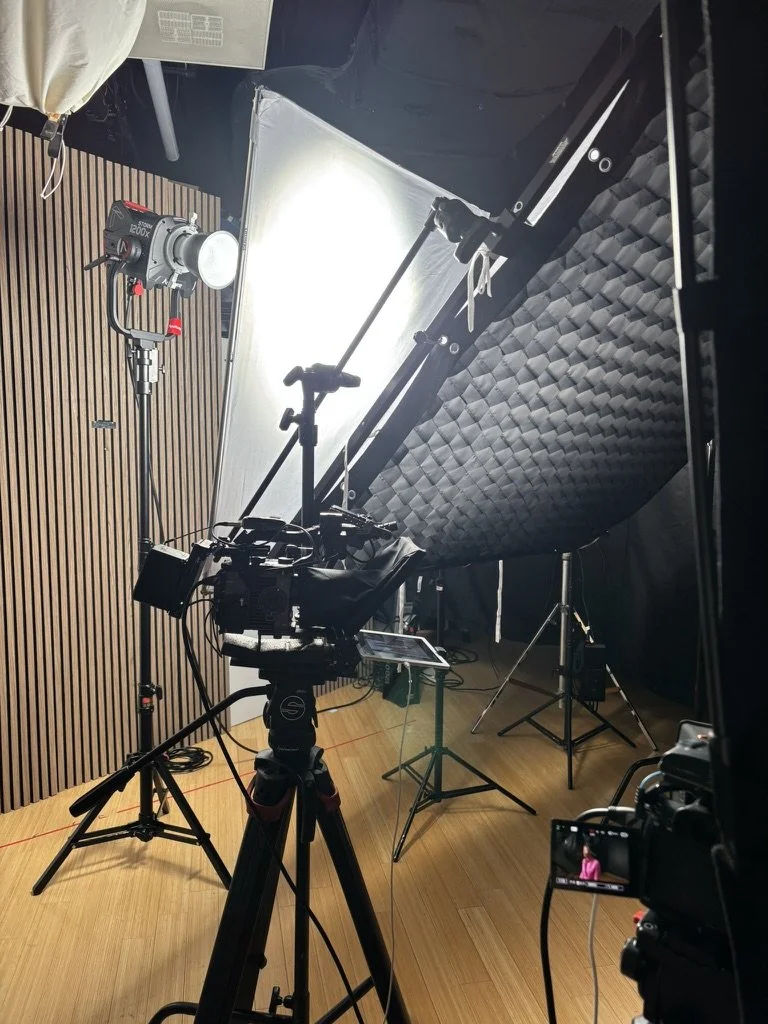
For a recent museum film project with Gallagher & Associates, we needed direct-eyeline interviews that felt intimate and authentic. Here's the setup:
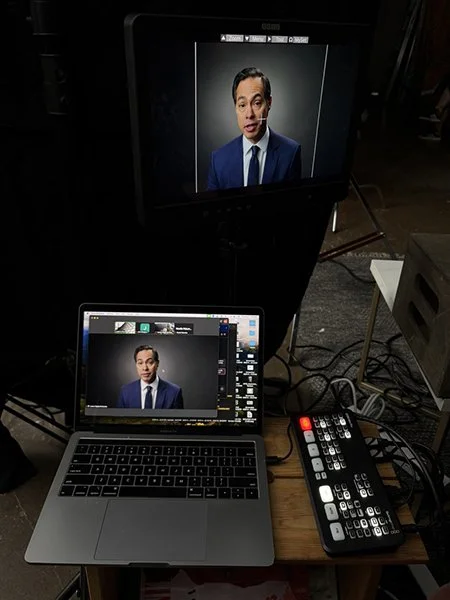
Main camera: Sony FX6 with an iPad teleprompter The connection: Zoom call reflecting our off-site producer's face onto the teleprompter glass
The feed: BlackMagic ATEM mixer routing the 4K camera signal back into Zoom so the producer could see the live shot
The result? A one-on-one Zoom call that used broadcast-quality 4K capture while allowing both producer and subject to look directly at each other. Natural. Intimate. Powerful.
And fully remote.
"Whoa, That's Cool."
When former HUD Secretary Julián Castro saw our setup, he stopped mid-conversation:
"Whoa, that's cool. I do a lot of these interviews and I've never seen that."
And you know what? It is cool.
Technology in Service of Emotion
Look, we geek out over gear. We love a good technical problem. But the tech is never the point.
The point is always the same: connection.
Every innovation we bring to set—from digital Interrotrons to AI deployment systems—exists for one reason: to make people feel something.
Because at the end of the day, nobody remembers your lighting setup or your camera rig.
They remember how you made them feel.
Want interviews that create real connection? Let's talk about how we can bring this approach to your next project. Hit us up.